## 1. Problem Statement
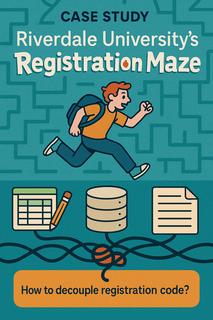
## **Case Study: Riverdale University’s Registration Maze**
At Riverdale University, students race to register for classes each semester:
- Some departments use spreadsheets, others use databases, and a few still keep paper records.
- When a student tries to enroll, their request is sometimes lost, or two systems accidentally double-book a seat.
- If the university wants to upgrade from spreadsheets to a new database, they worry about rewriting all their registration logic.
- Testing new features is risky, because the code is tightly coupled to the current storage method.
 **The challenge:**
How can you build a course registration system where the rules and features work no matter how or where the data is stored-so you can upgrade, test, and scale without rewriting everything?
----------
## 2. Learning Objectives
By the end of this tutorial, you will:
- Understand the Repository Pattern and its purpose.
- Create repository interfaces to abstract data access.
- Implement repositories for different storage types (memory, file, database).
- Swap storage backends without changing business logic.
- Write tests using mock repositories.
- Apply best practices and avoid common pitfalls.
----------
## 3. Concept Introduction with Analogy
## **Analogy: The University Records Office**
Imagine the records office:
- Professors and students submit requests (“Add me to Physics 101!”).
- The office staff don’t care if records are in filing cabinets, spreadsheets, or a fancy database-they just use a standard form.
- If the university upgrades to a new system, the process for students and staff stays the same.
**The Repository Pattern is like this standardized records office:**
- All requests go through a single interface, no matter where the data lives.
- The rest of the university never worries about how records are stored or retrieved.
----------
## 4. Technical Deep Dive
## **A. What is the Repository Pattern?**
The Repository Pattern is a design pattern that centralizes data access logic in a single place, separating it from business logic.
- **Purpose:**
- Abstracts the details of data storage and retrieval from the rest of the application.
- Provides a collection-like interface for accessing domain objects.
- Makes it easy to swap storage backends (e.g., memory, file, database) without changing business logic.
- **Benefits:**
- Centralized, maintainable data access code.
- Business logic is decoupled from storage details.
- Easier testing (mock repositories).
- Reduces code duplication and errors.
## **B. Repository Pattern in Practice**
**Key Components:**
- **Repository Interface:**
- Defines the operations for a resource (CRUD, custom queries).
- Example: `ICourseRepository` with methods like `findAll`, `findById`, `save`, `enrollStudent`.
- **Repository Implementation:**
- Handles the actual data access logic (memory, file, database).
- Can be swapped out without changing the rest of the app.
- **Domain Model:**
- The data structure (e.g., `Course`) the repository manages.
- **Business Logic Layer (Service):**
- Uses the repository interface, not the implementation, to enforce rules and policies.
## **C. Why Not Access Data Directly?**
If you mix data access and business logic:
- Every change in storage (e.g., new database) forces you to rewrite all logic.
- Testing is hard-you need a real database for every test.
- Code is harder to read, debug, and maintain.
## **D. Best Practices**
- Define repository interfaces in the domain layer
- Create one repository per aggregate root (main entity, e.g., Course, Student).
- Never expose storage-specific types or queries (e.g., SQL, ORM objects) to business logic.
- Use dependency injection to provide repository implementations.
- Test business logic with mock or in-memory repositories.
----------
## 5. Step-by-Step Data Modeling & Code Walkthrough
Let’s build a robust course registration system using the Repository Pattern.
## **A. Define the Domain Model**
```typescript
// models/Course.ts
export interface Course {
id: string;
name: string;
capacity: number;
students: string[];
}
```
## **B. Create the Repository Interface**
```typescript
// repositories/interfaces/ICourseRepository.ts
export interface ICourseRepository {
findAll(): Promise;
findById(id: string): Promise;
save(course: Course): Promise;
enrollStudent(courseId: string, studentId: string): Promise;
findByStudentId(studentId: string): Promise;
}
```
- **Why?**
- This interface is the “standard form” for the records office.
- Business logic only talks to this interface, never to storage details.
## **C. Implement an In-Memory Repository**
```typescript
// repositories/InMemoryCourseRepository.ts
import { ICourseRepository } from './interfaces/ICourseRepository';
import { Course } from '../models/Course';
export class InMemoryCourseRepository implements ICourseRepository {
private courses: Course[] = [];
async findAll(): Promise {
return this.courses;
}
async findById(id: string): Promise {
return this.courses.find(course => course.id === id) || null;
}
async save(course: Course): Promise {
const idx = this.courses.findIndex(c => c.id === course.id);
if (idx >= 0) {
this.courses[idx] = course;
} else {
this.courses.push(course);
}
}
async enrollStudent(courseId: string, studentId: string): Promise {
const course = await this.findById(courseId);
if (course && !course.students.includes(studentId)) {
course.students.push(studentId);
await this.save(course);
}
}
async findByStudentId(studentId: string): Promise {
return this.courses.filter(course => course.students.includes(studentId));
}
}
```
- **Why?**
- All data access is here.
- If you switch to a database, only this file changes.
## **D. Implement a Database Repository (Example Outline)**
```typescript
// repositories/DatabaseCourseRepository.ts
import { ICourseRepository } from './interfaces/ICourseRepository';
import { Course } from '../models/Course';
export class DatabaseCourseRepository implements ICourseRepository {
// Assume db is a connected database client
constructor(private db: any) {}
async findAll(): Promise {
// Use real database queries here
return this.db.query('SELECT * FROM courses');
}
async findById(id: string): Promise {
// ...
return null; // Example
}
// ...implement other methods
}
```
- **Why?**
- You can now swap between in-memory and database storage without changing business logic.
## **E. Use the Repository in a Service**
```typescript
// services/CourseService.ts
import { ICourseRepository } from '../repositories/interfaces/ICourseRepository';
export class CourseService {
constructor(private courseRepo: ICourseRepository) {}
async enroll(courseId: string, studentId: string) {
const course = await this.courseRepo.findById(courseId);
if (!course) throw new Error('Course not found');
if (course.students.length >= course.capacity) throw new Error('Course full');
await this.courseRepo.enrollStudent(courseId, studentId);
return { message: 'Enrolled successfully' };
}
async getStudentCourses(studentId: string) {
return this.courseRepo.findByStudentId(studentId);
}
}
```
- **Why?**
- The service only knows about the repository interface, not how data is stored.
## **F. Hook Up in Your App**
```typescript
// app.ts
import express from 'express';
import { InMemoryCourseRepository } from './repositories/InMemoryCourseRepository';
import { CourseService } from './services/CourseService';
const app = express();
app.use(express.json());
const courseRepo = new InMemoryCourseRepository();
const courseService = new CourseService(courseRepo);
app.post('/courses/:id/enroll', async (req, res) => {
try {
const result = await courseService.enroll(req.params.id, req.body.studentId);
res.json(result);
} catch (e) {
res.status(400).json({ error: e.message });
}
});
app.get('/students/:id/courses', async (req, res) => {
const courses = await courseService.getStudentCourses(req.params.id);
res.json(courses);
});
app.listen(3000, () => console.log('Server running on port 3000'));
```
## 6. Challenge
**Your Turn!**
- Implement a `delete(courseId: string)` method in the repository.
- Add a service and route to allow admins to delete a course.
## 7. Common Pitfalls & Best Practices
| **Pitfall** | **Best Practice** |
|-------------------------------------------|--------------------------------------------------------|
| Mixing data access in business logic | Always use repositories for storage access |
| Hardcoding storage details everywhere | Depend on interfaces, not implementations |
| Not testing with mocks | Use fake repositories for unit tests |
| Exposing storage-specific types to logic | Only return domain models from repositories |
| Not updating the repository interface | Keep interfaces up to date with business needs |
## 8. Optional: Programmer’s Workflow Checklist
- Define repository interfaces for all major resources.
- Implement repositories for each storage type (memory, file, database).
- Never access storage directly from services or controllers-use repositories.
- Swap repository implementations easily for testing or upgrades.
- Write unit tests with mock repositories.
- Don’t expose storage-specific types or queries to business logic.
- Keep repository interfaces in the domain layer.
----------
## 9. Coming up Next
Learn how to use Dependency Injection to provide repositories to your services and controllers automatically-making your app even more modular, testable, and ready for growth!
----------
**The challenge:**
How can you build a course registration system where the rules and features work no matter how or where the data is stored-so you can upgrade, test, and scale without rewriting everything?
----------
## 2. Learning Objectives
By the end of this tutorial, you will:
- Understand the Repository Pattern and its purpose.
- Create repository interfaces to abstract data access.
- Implement repositories for different storage types (memory, file, database).
- Swap storage backends without changing business logic.
- Write tests using mock repositories.
- Apply best practices and avoid common pitfalls.
----------
## 3. Concept Introduction with Analogy
## **Analogy: The University Records Office**
Imagine the records office:
- Professors and students submit requests (“Add me to Physics 101!”).
- The office staff don’t care if records are in filing cabinets, spreadsheets, or a fancy database-they just use a standard form.
- If the university upgrades to a new system, the process for students and staff stays the same.
**The Repository Pattern is like this standardized records office:**
- All requests go through a single interface, no matter where the data lives.
- The rest of the university never worries about how records are stored or retrieved.
----------
## 4. Technical Deep Dive
## **A. What is the Repository Pattern?**
The Repository Pattern is a design pattern that centralizes data access logic in a single place, separating it from business logic.
- **Purpose:**
- Abstracts the details of data storage and retrieval from the rest of the application.
- Provides a collection-like interface for accessing domain objects.
- Makes it easy to swap storage backends (e.g., memory, file, database) without changing business logic.
- **Benefits:**
- Centralized, maintainable data access code.
- Business logic is decoupled from storage details.
- Easier testing (mock repositories).
- Reduces code duplication and errors.
## **B. Repository Pattern in Practice**
**Key Components:**
- **Repository Interface:**
- Defines the operations for a resource (CRUD, custom queries).
- Example: `ICourseRepository` with methods like `findAll`, `findById`, `save`, `enrollStudent`.
- **Repository Implementation:**
- Handles the actual data access logic (memory, file, database).
- Can be swapped out without changing the rest of the app.
- **Domain Model:**
- The data structure (e.g., `Course`) the repository manages.
- **Business Logic Layer (Service):**
- Uses the repository interface, not the implementation, to enforce rules and policies.
## **C. Why Not Access Data Directly?**
If you mix data access and business logic:
- Every change in storage (e.g., new database) forces you to rewrite all logic.
- Testing is hard-you need a real database for every test.
- Code is harder to read, debug, and maintain.
## **D. Best Practices**
- Define repository interfaces in the domain layer
- Create one repository per aggregate root (main entity, e.g., Course, Student).
- Never expose storage-specific types or queries (e.g., SQL, ORM objects) to business logic.
- Use dependency injection to provide repository implementations.
- Test business logic with mock or in-memory repositories.
----------
## 5. Step-by-Step Data Modeling & Code Walkthrough
Let’s build a robust course registration system using the Repository Pattern.
## **A. Define the Domain Model**
```typescript
// models/Course.ts
export interface Course {
id: string;
name: string;
capacity: number;
students: string[];
}
```
## **B. Create the Repository Interface**
```typescript
// repositories/interfaces/ICourseRepository.ts
export interface ICourseRepository {
findAll(): Promise;
findById(id: string): Promise;
save(course: Course): Promise;
enrollStudent(courseId: string, studentId: string): Promise;
findByStudentId(studentId: string): Promise;
}
```
- **Why?**
- This interface is the “standard form” for the records office.
- Business logic only talks to this interface, never to storage details.
## **C. Implement an In-Memory Repository**
```typescript
// repositories/InMemoryCourseRepository.ts
import { ICourseRepository } from './interfaces/ICourseRepository';
import { Course } from '../models/Course';
export class InMemoryCourseRepository implements ICourseRepository {
private courses: Course[] = [];
async findAll(): Promise {
return this.courses;
}
async findById(id: string): Promise {
return this.courses.find(course => course.id === id) || null;
}
async save(course: Course): Promise {
const idx = this.courses.findIndex(c => c.id === course.id);
if (idx >= 0) {
this.courses[idx] = course;
} else {
this.courses.push(course);
}
}
async enrollStudent(courseId: string, studentId: string): Promise {
const course = await this.findById(courseId);
if (course && !course.students.includes(studentId)) {
course.students.push(studentId);
await this.save(course);
}
}
async findByStudentId(studentId: string): Promise {
return this.courses.filter(course => course.students.includes(studentId));
}
}
```
- **Why?**
- All data access is here.
- If you switch to a database, only this file changes.
## **D. Implement a Database Repository (Example Outline)**
```typescript
// repositories/DatabaseCourseRepository.ts
import { ICourseRepository } from './interfaces/ICourseRepository';
import { Course } from '../models/Course';
export class DatabaseCourseRepository implements ICourseRepository {
// Assume db is a connected database client
constructor(private db: any) {}
async findAll(): Promise {
// Use real database queries here
return this.db.query('SELECT * FROM courses');
}
async findById(id: string): Promise {
// ...
return null; // Example
}
// ...implement other methods
}
```
- **Why?**
- You can now swap between in-memory and database storage without changing business logic.
## **E. Use the Repository in a Service**
```typescript
// services/CourseService.ts
import { ICourseRepository } from '../repositories/interfaces/ICourseRepository';
export class CourseService {
constructor(private courseRepo: ICourseRepository) {}
async enroll(courseId: string, studentId: string) {
const course = await this.courseRepo.findById(courseId);
if (!course) throw new Error('Course not found');
if (course.students.length >= course.capacity) throw new Error('Course full');
await this.courseRepo.enrollStudent(courseId, studentId);
return { message: 'Enrolled successfully' };
}
async getStudentCourses(studentId: string) {
return this.courseRepo.findByStudentId(studentId);
}
}
```
- **Why?**
- The service only knows about the repository interface, not how data is stored.
## **F. Hook Up in Your App**
```typescript
// app.ts
import express from 'express';
import { InMemoryCourseRepository } from './repositories/InMemoryCourseRepository';
import { CourseService } from './services/CourseService';
const app = express();
app.use(express.json());
const courseRepo = new InMemoryCourseRepository();
const courseService = new CourseService(courseRepo);
app.post('/courses/:id/enroll', async (req, res) => {
try {
const result = await courseService.enroll(req.params.id, req.body.studentId);
res.json(result);
} catch (e) {
res.status(400).json({ error: e.message });
}
});
app.get('/students/:id/courses', async (req, res) => {
const courses = await courseService.getStudentCourses(req.params.id);
res.json(courses);
});
app.listen(3000, () => console.log('Server running on port 3000'));
```
## 6. Challenge
**Your Turn!**
- Implement a `delete(courseId: string)` method in the repository.
- Add a service and route to allow admins to delete a course.
## 7. Common Pitfalls & Best Practices
| **Pitfall** | **Best Practice** |
|-------------------------------------------|--------------------------------------------------------|
| Mixing data access in business logic | Always use repositories for storage access |
| Hardcoding storage details everywhere | Depend on interfaces, not implementations |
| Not testing with mocks | Use fake repositories for unit tests |
| Exposing storage-specific types to logic | Only return domain models from repositories |
| Not updating the repository interface | Keep interfaces up to date with business needs |
## 8. Optional: Programmer’s Workflow Checklist
- Define repository interfaces for all major resources.
- Implement repositories for each storage type (memory, file, database).
- Never access storage directly from services or controllers-use repositories.
- Swap repository implementations easily for testing or upgrades.
- Write unit tests with mock repositories.
- Don’t expose storage-specific types or queries to business logic.
- Keep repository interfaces in the domain layer.
----------
## 9. Coming up Next
Learn how to use Dependency Injection to provide repositories to your services and controllers automatically-making your app even more modular, testable, and ready for growth!
----------